
How to Check for a Warrant in Summit County
Start with jurisdiction, not a broad name search. That choice shapes everything after it. A paper marked Summit County Justice Center belongs on the Colorado Judicial Branch route, while a Breckenridge, Silverthorne, Dillon, Keystone, Frisco, or Blue River matter may belong to that town's municipal court instead. Before you send anything, gather the case or ticket number, the court name, the likely filing year, and any appearance date. Those details beat a name alone and cut down false matches. One caution: the Summit County Sheriff records form covers reports, bookings, and citation material, but it is not a live warrant-status tool. If the issuing office is unclear, call the Summit Combined Courts clerk or the municipal clerk first rather than sending personal details to the wrong office.
- Read the notice for its court, case or citation number, and appearance date.
- Use the Colorado Judicial docket search for a district or county court matter.
- Check the named municipal court separately when a town issued the citation or summons.
- Request the precise court or agency document if the public interface does not answer the question.
- Confirm current status and resolution instructions with the issuing court before acting.
Summit County Has No Single Warrant Portal
Summit County publishes no single name-search warrant portal. The Sheriff's site offers agency news plus a detailed criminal-justice records request, and the Judicial Branch offers dockets and document requests. Neither counts as a full active-warrant list. Municipal pages publish calendars, payment routes, and court instructions, not countywide warrant rosters.
Quick answer: A blank docket or missing Sheriff page is not proof that no warrant exists; confirm with the court that controls the case.
That gap makes the fallback chain matter. Check the official docket in Summit County, call the named court, and request the specific record from the office that holds it. A spelling variation, a restricted case, a wrong date, or the wrong courthouse can all explain why a public search returns nothing.
Types of Warrants in Summit County
Warrant records in Summit County can start in District Court, County Court, or a municipal court. The label tells you why a judge acted. It also points to the office that can discuss recall, appearance, bond, or document access.
| Warrant Type | How It Arises | Likely Issuer |
|---|---|---|
| Arrest warrant | A judge authorizes an arrest in a criminal matter. | District, county, or municipal court |
| Bench warrant | A required appearance is missed or an order is not followed. | Judge handling the case |
| Search warrant | A judge authorizes a search; affidavit access follows separate limits. | Court with jurisdiction |
| Outstanding Judgment Warrant | Breckenridge uses this term for certain unresolved municipal judgments. | Breckenridge Municipal Court |
Summit County Warrant Docket Search
The Colorado docket tool is the main public entry point for state-court matters in Summit County. It filters by judicial district, county, courthouse, court type, division, date, case, party, and attorney. Its notice requires a date plus at least one other filter. By design, then, an open-ended name query is not the same as a current warrant certification.
| Field | Best Use | Limit |
|---|---|---|
| Location | Select Fifth Judicial District and Summit County. | The wrong courthouse can hide a relevant event. |
| Date | Search around the known hearing or filing date. | A narrow range may miss a rescheduled matter. |
| Case | Use year, class, and sequence when known. | A ticket number may not match a court case format. |
| Party | Use exact spelling only when needed. | Names can produce ambiguous matches. |
A hearing titled "Appearance on Arrest Warrant" is a docket event, not the whole Summit County warrant record. Write down the court and the event, then ask the clerk about current status.
What a Summit County Warrant Record Shows
Summit County publishes no model warrant for public display. An official docket entry, court order, or written court response may carry some of the fields below, though what appears varies by record type and access status. A single field in isolation cannot confirm whether a warrant stands today.
| Record identifier | A court case, warrant, or citation number such as YEAR-CLASS-SEQUENCE; formats differ by system. |
|---|---|
| Issuing authority | The district, county, or municipal court responsible for the order. |
| Issue information | The date and legal process associated with issuance, when public. |
| Offense or case class | The alleged matter linked to the proceeding, not a finding of guilt. |
| Appearance or bond | Instructions or terms only when the court releases them. |
| Status or return | Service, recall, execution, or related entry, subject to clerk confirmation. |
Three Summit Records Routes Answer Different Questions
Summit County gives you three distinct records routes. A docket search, a court document request, and a Sheriff records request each answer a different question. Use the docket for public hearing and case information. Use the Judicial Branch request form when you need a court order, docket entry, or other court-held document. Use the Sheriff form for an agency report, booking record, citation record, or other law-enforcement material.
- Docket
- A public schedule or case-event view that may not display a live warrant flag.
- Court record request
- A request to the judicial custodian for a named document or case record.
- Sheriff records request
- A request under criminal-justice-record rules for agency-held material, not a public warrant lookup.
Timelines differ by route. The statewide court form may require identification for protected records and generally describes a three-business-day response unless more time is needed. Summit's local form states three to five business days. The Sheriff confirms fees before release, and complex requests may use the statutory 72-hour period.
Who Issues and Serves Summit County Warrants
Judges in the Fifth Judicial District's District and County Courts issue warrants within their jurisdiction. Municipal judges handle town ordinance, traffic, animal, and certain lower-level matters. The Summit County Sheriff and municipal police serve papers and make arrests. Still, no agency holding a report can change a judicial order.
Summit Combined Courts
Summit County Justice Center, 501 N. Park Avenue
Breckenridge, CO 80424
970-453-2272
Summit County Sheriff’s Office
501 N. Park Avenue
Breckenridge, CO 80424
970-453-2232
The official Sheriff entry page is shown in the source image below.
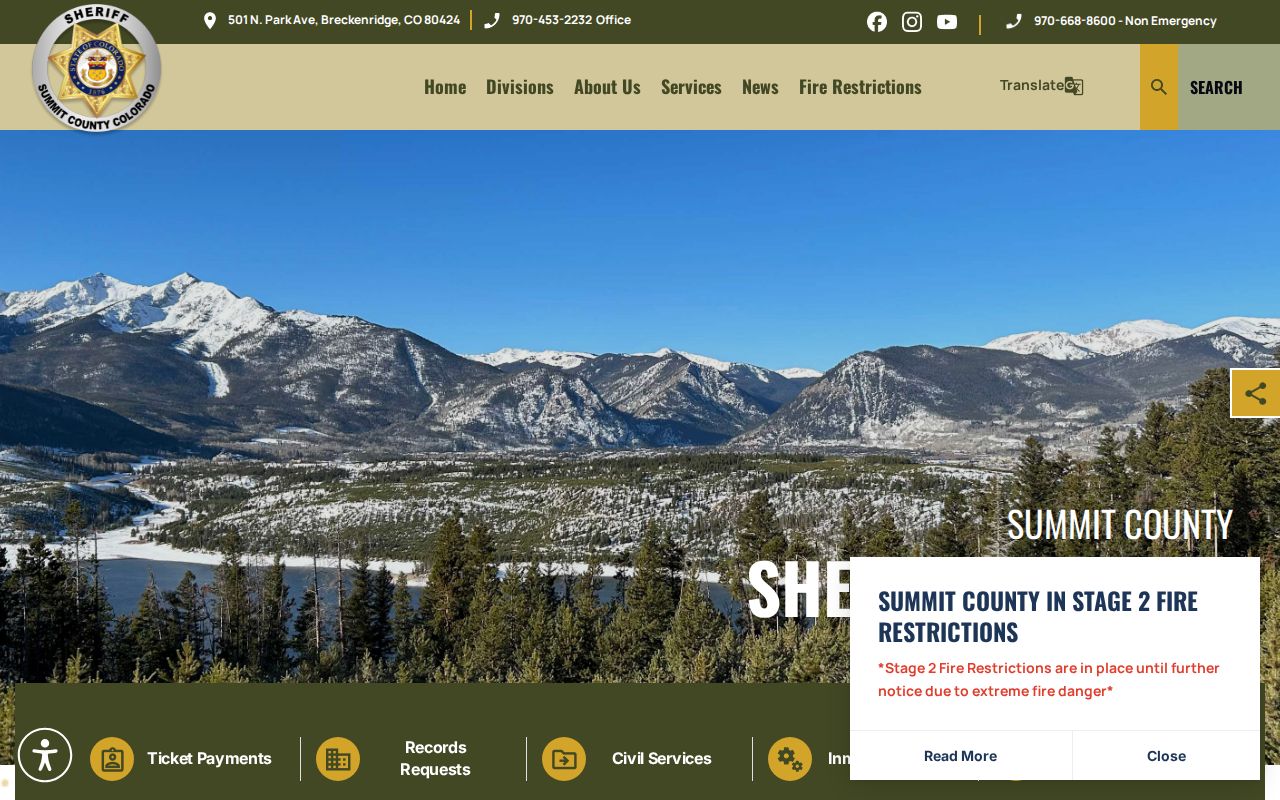
The agency page is an official starting point. Current status still comes from the issuing court or its record system in Summit County.
The Justice Center Is the State-Court Hub
State District and County Court matters run through Summit Combined Courts at the Justice Center in Breckenridge. Public hours are Monday through Friday, 8:00 a.m. to 5:00 p.m. The Clerk's Office closes from 4:00 to 5:00 p.m. on the first and third Thursday of each month. Mail reaches the clerk at P.O. Box 269, Breckenridge, CO 80424, and the clerk email is 5thJDclerks@judicial.state.co.us. The official Summit County court page shows the Justice Center and its court-service links.
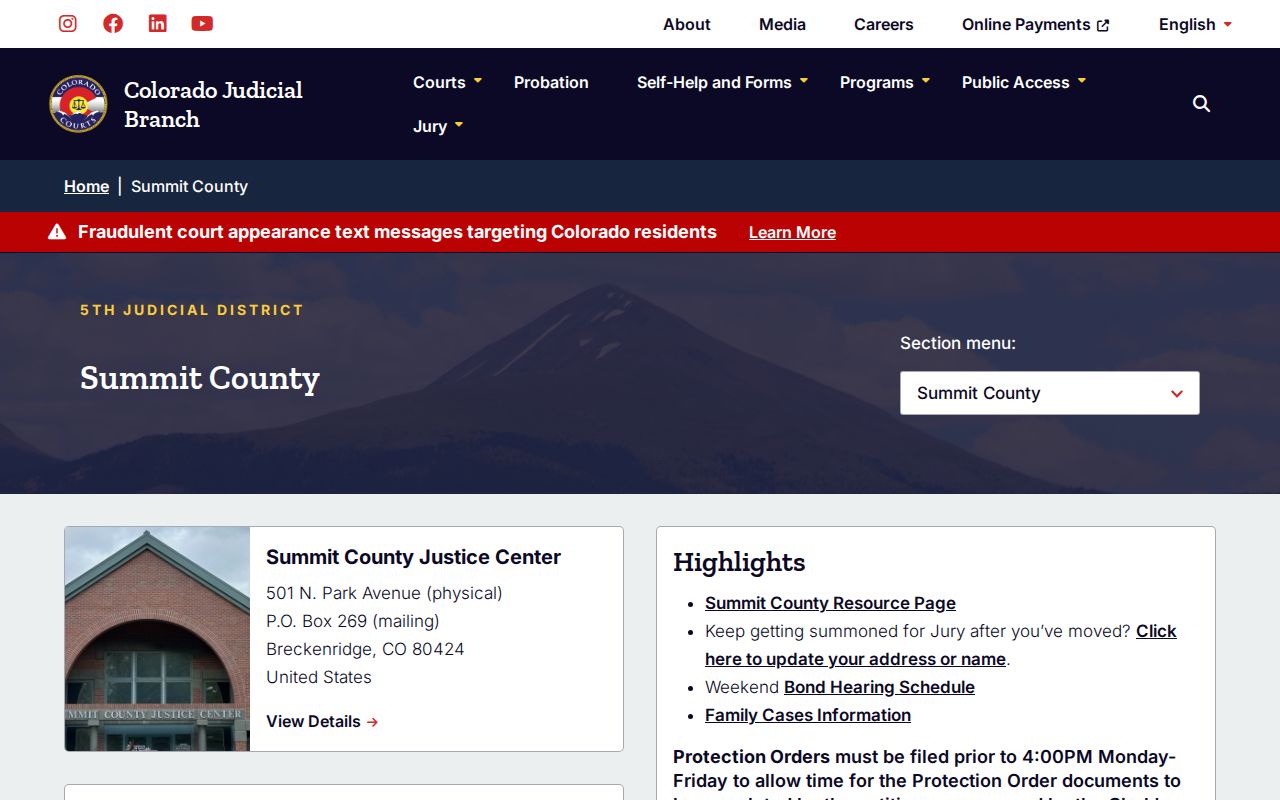
That page is the working hub for Summit County docket, payment, record-request, and self-help routes tied to a state case.
What to Do If You Have a Summit County Warrant
Call the issuing court first. That call tells you what a Summit County warrant actually requires: a scheduled appearance, a bond, a payment, a motion to recall or quash, counsel, or another court-directed step. The county pages publish no single walk-in process that clears every state, county, and municipal warrant. A records request will not recall a warrant either. Some towns do lay out exact routes. Breckenridge offers three: police surrender with bond, a prearranged direct bond payment, or court-day surrender during its stated window. The combined Silverthorne, Dillon, and Keystone court accepts jail surrender or a court-day appearance. Keep those local steps away from District or County Court cases in Summit County.
Important: Contact the issuing court and consider speaking with a Colorado lawyer before surrender, payment, travel, or any step that may carry legal consequences.
Summit’s September Warrant Event Has Limits
One dated option stands out. The Fifth Judicial District announced a “Clear Your Warrant” event for September 19, 2026 at the Summit County Justice Center. Eligible warrants from Summit, Lake, Eagle, and Clear Creek counties qualify. A judge sees you there without arrest. Not every warrant makes the cut. Warrants tied to victims, state probation, or out-of-district cases are excluded, which makes this a limited court event rather than a standing amnesty. The official Judicial Branch announcement carries the full eligibility terms and an event contact. Confirm its current status before travel.
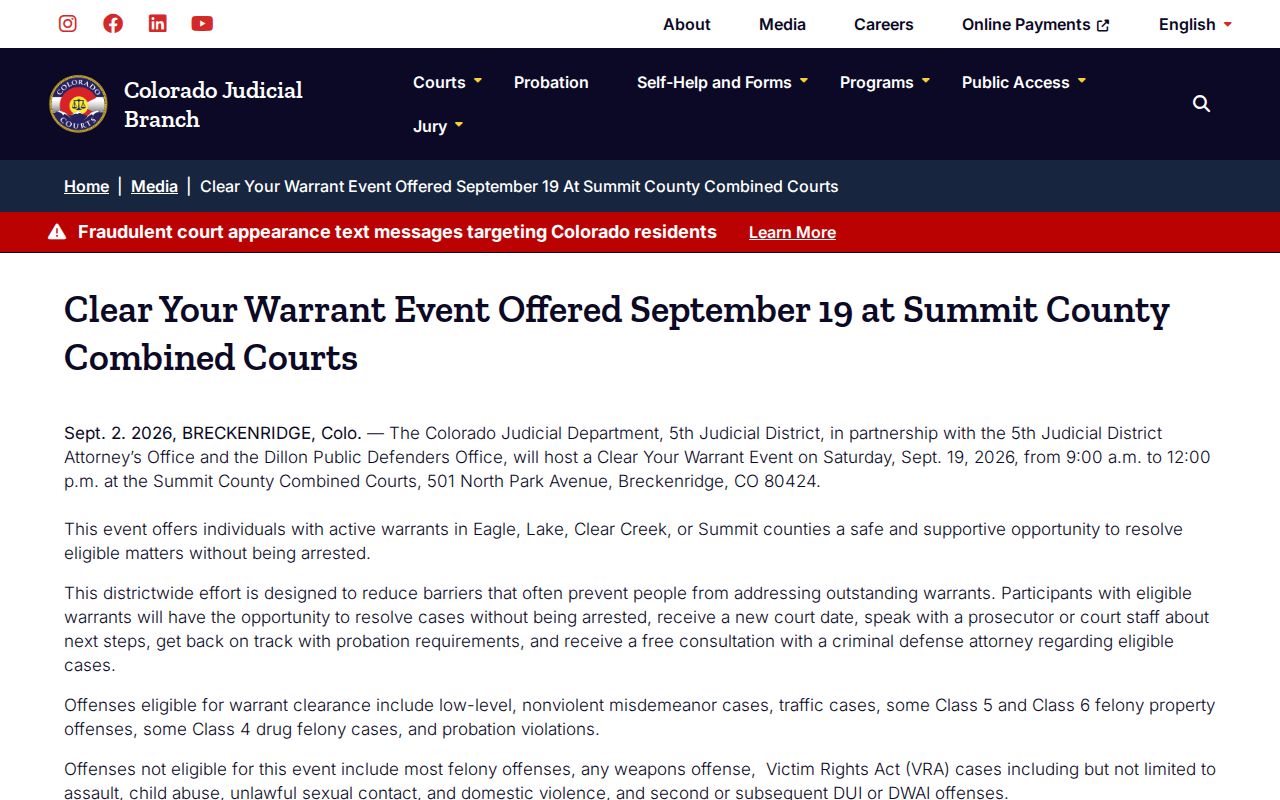
Its limits are exactly why a local event cannot replace case-specific instructions from the issuing court handling your Summit County warrant.
Public Access to Summit County Warrant Records
Access works differently by record type. Court records follow Judicial Branch rules, directives, statutes, and orders. Sheriff reports and other Summit County agency material answer to the Colorado Criminal Justice Records Act instead. The Colorado Open Records Act opens many government records, but a seal, juvenile protections, an active investigation, privilege, or a court order can still close them.
Key rules:
Colorado Open Records Act, C.R.S. 24-72-201 et seq. establishes access to many public records subject to lawful exceptions.
Colorado Criminal Justice Records Act, C.R.S. 24-72-301 et seq. governs many records held by police and the Sheriff.
Administrative Order 1996-03 restricts arrest- and search-warrant affidavits before execution and permits continued nondisclosure for good cause.
Some records stay out of reach. Juvenile, sealed, suppressed, confidential, and protected material may never surface through ordinary public channels, so ask the keeper of Summit County records for any releasable portion and for the authority behind a denial or redaction.
Municipal Warrants Stay With Their Town Courts
Summit County’s municipal side is not one office. Breckenridge runs its own court. Silverthorne operates a combined court for Silverthorne, Dillon, and Keystone at Silverthorne Town Hall. Frisco keeps a separate Municipal Court. Blue River confirms municipal judicial services but posts no self-service warrant portal and no current clerk phone. Never treat a municipal payment screen as a warrant search. Keep the exact jurisdiction printed on the ticket. Picking Silverthorne, Dillon, or Keystone may land you in the same payment provider, yet the printed place and case still control routing. A Frisco ticket naming the Summit County Justice Center belongs on the state-court route, not Frisco’s town payment route.
Summit Traffic Tickets Split Into Two Systems
Breckenridge splits its tickets by color. Yellow means municipal; blue means state. Frisco goes by the court named on the citation. Municipal citations go to the town court, while state citations go to Summit Combined Courts and the official state route. Paying online may settle an eligible amount, but it will not necessarily reveal a missed appearance, a warrant, a bond, or a remaining date in Summit County.
- Failure to appear
- A missed required court setting that may prompt a bench warrant under the applicable process.
- Outstanding Judgment Warrant
- Breckenridge’s term for certain unresolved municipal judgments, which its FAQ says may create a driver-license hold.
- Mandatory appearance
- A direction to appear that controls over a general online payment option.
Never guess a jurisdiction when a ticket is lost. Call the Summit County clerk, keep your payment confirmation, and ask whether any appearance or warrant issue remains.
Summit Most-Wanted Search Limits
The Sheriff posts no public warrant roster. Summit County has no downloadable active-warrant list, no Crime Stoppers warrant program, no warrant-specific tip line, no reward schedule, and no fixed publication cadence. The municipal courts publish no name lists either. The news index still helps. Check the Sheriff’s official news index for new agency announcements about Summit County warrants. Skip commercial people-search pages, other states’ Summit County listings, and law-enforcement-only systems. Never confront anyone over an online claim. Use emergency services for an immediate safety threat and the agency’s published non-emergency contact for anything else.
Warrant Records by City in Summit County
The 2020 Census profiles document five incorporated places. Each place in Summit County has its own court and police routes, and each city page sticks to that municipal process and flags when a ticket belongs to Summit Combined Courts. Population is not warrant volume.
Breckenridge Warrant Records
Population 5,078 · Separate Municipal Court with detailed clearance instructions.
Silverthorne Warrant Records
Population 4,402 · Home of the combined Silverthorne, Dillon, and Keystone court.
Frisco Warrant Records
Population 2,913 · Municipal Court separates town and state citations.
Dillon Warrant Records
Population 1,064 · Local police route with court service based in Silverthorne.
Blue River Warrant Records
Population 877 · Municipal judicial services with routing through Town Hall.
Start with the city printed on the notice. Move to the Summit County route when the document names the Justice Center or the municipal clerk directs that handoff.